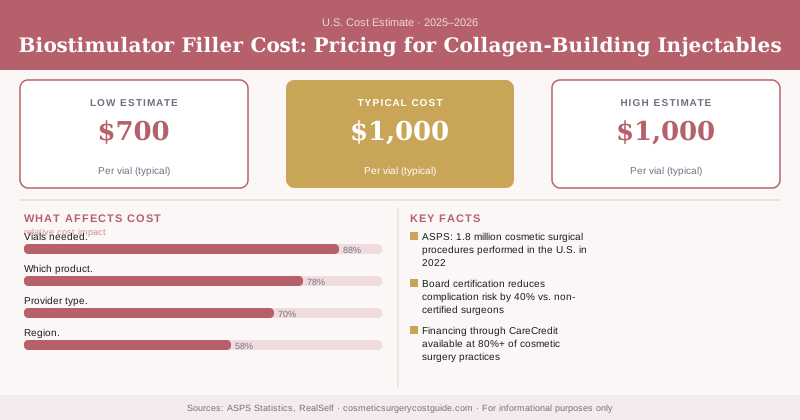
Here’s a quote that confuses people: “$800 a vial, and you’ll need two or three vials, spread over a few months.” That’s biostimulator filler pricing — and it works completely differently from the syringe-by-syringe math you know from hyaluronic acid.
Biostimulator fillers don’t just fill space. They prompt your own body to build new collagen over weeks and months, so the result develops gradually and tends to last longer than traditional fillers. The two best-known are poly-L-lactic acid (Sculptra, FDA-approved for aesthetic use in 2009) and calcium hydroxylapatite (Radiesse). Because the effect is regenerative and cumulative, they’re priced and dosed as a course — not as a one-and-done syringe.
Biostimulator filler pricing breakdown
| Treatment | Cost |
|---|---|
| Per vial (typical) | $700–$1,000 |
| Starter course (2 vials) | $1,400–$2,000 |
| Full course (3–4 vials) | $2,100–$4,000 |
| Cheeks/midface course | $1,500–$3,500 |
| Maintenance vial (annual) | $700–$1,000 |
Why biostimulators are priced as a course
Because biostimulators trigger gradual collagen production, you typically need a series of sessions — often two to four, spaced four to six weeks apart — to reach the full result. Each session uses one or more vials. The collagen builds over three to six months, and results can last two years or more, which is part of the value argument.
So the per-vial price of $700–$1,000 is only one piece. Your real cost is the full course, usually $1,400–$4,000 depending on how much volume you’re restoring. The Aesthetic Society has reported steady demand for collagen-stimulating injectables alongside the broader filler boom, where millions of soft-tissue procedures happen each year.
Biostimulator fillers cost $700–$1,000 per vial, but they’re sold as a course — budget $1,400–$4,000 for the 2–4 vials that build full collagen results. The upside: results develop naturally and can last 2+ years, so the cost-per-year can beat traditional filler. The downside: bigger upfront spend and patience required.
What affects your total
Vials needed. The biggest driver. More volume loss means more vials and a higher total.
Which product. Poly-L-lactic acid and calcium hydroxylapatite are priced similarly per vial but behave differently and suit different goals.
Provider type. Dermatology and plastic surgery offices price above medspas, and biostimulators reward injector experience because placement and dilution matter.
Region. Coastal metros add 30–50% over the national midpoint.
How biostimulators compare
The headline biostimulator is Sculptra, which has its own detailed pricing. If you want immediate volume that’s fully reversible, a hyaluronic acid product from the dermal fillers category is the better fit — biostimulators are slower and not reversible the same way. Some patients use both: filler for instant correction, biostimulator for long-term collagen. They’re also commonly paired with collagen-stimulating energy treatments like Morpheus8.
Biostimulators are not reversible the way hyaluronic acid is — you can’t simply dissolve them if you don’t like the result. That makes injector skill even more important here than with HA filler. Overcorrection or poor placement is harder to fix and may take time to resolve on its own. Choose someone with deep biostimulator experience.
Common questions
How long do results last? Often two years or more, since you’re building your own collagen — longer than most hyaluronic acid fillers.
Why don’t I see results right away? The collagen builds gradually over months. Early on, any volume you see is mostly the carrier fluid, which absorbs within days.
Does insurance cover it? No — purely cosmetic. Many practices accept financing to spread the larger upfront course cost.
Bottom line
Biostimulator fillers cost $700–$1,000 per vial and $1,400–$4,000 for a full course. They build your own collagen for natural, long-lasting results — but they require patience, a bigger upfront spend, and an experienced injector since they’re not easily reversible. For long-term volume restoration, the cost-per-year can be a genuine bargain.
Frequently Asked Questions
A complete Biostimulator treatment course typically costs $1,400–$4,000, since most patients need two to three vials spread over several months to achieve optimal collagen-building results. Each vial alone runs $700–$1,000, depending on your provider's location and experience level.
No—Biostimulator is considered a cosmetic procedure and is not covered by health insurance plans. You'll pay the full out-of-pocket cost, though some practices offer payment plans to spread the $1,400–$4,000 total across multiple months.
Most patients receive 2–3 vials of Biostimulator over 2–4 months, with injections spaced 4–6 weeks apart to allow collagen production to build gradually. Results continue to improve for up to 12 months after your final treatment, making this a longer-term investment than traditional fillers that work immediately.