Your breast feels hard. It sits too high, looks distorted, and some days it aches. That’s capsular contracture, and it’s the single most common reason women end up back in the operating room after breast augmentation. The FDA notes that capsular contracture is among the leading complications driving implant reoperation, and it doesn’t fix itself.
Here’s the uncomfortable part: fixing it usually costs more than the original augmentation did. You’re paying for a more complex surgery on tissue that’s already been operated on once.
What Drives the Cost
Every implanted device forms a scar capsule around it — that’s normal. Contracture happens when that capsule tightens and squeezes. Surgeons grade it from I (soft, normal) to IV (hard, painful, visibly distorted). Grade III and IV almost always need surgery. The grade you’re at largely sets your price.
Capsular Contracture Treatment Cost
| Treatment | Cost Range | What It Involves |
|---|---|---|
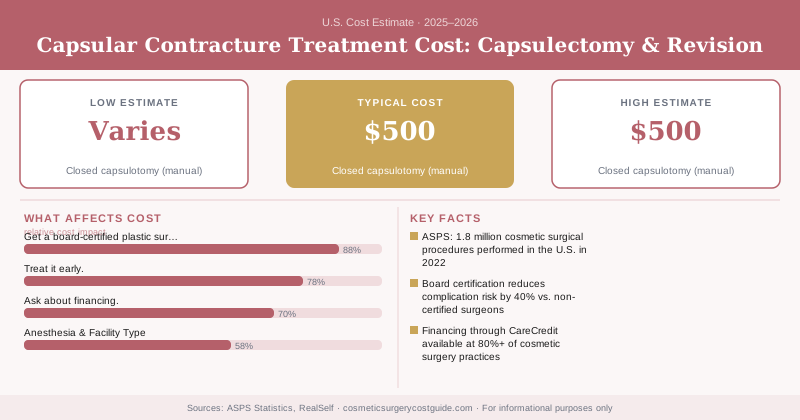
| Closed capsulotomy (manual) | $0–$500 | Squeezing to break capsule — rarely done, risky |
| Open capsulotomy | $2,500–$5,000 | Surgically releasing the capsule |
| Partial capsulectomy | $4,000–$8,000 | Removing part of the scar capsule |
| Total capsulectomy | $6,000–$10,000 | Removing the entire capsule |
| En bloc capsulectomy | $8,000–$14,000 | Removing capsule and implant as one unit |
| Capsulectomy + implant exchange | $8,000–$12,000 | Remove capsule, place new implant |
| Add-on: acellular dermal matrix | $1,500–$4,000 | Mesh to reduce recurrence |
These figures usually bundle the surgeon’s fee, anesthesia, and a surgical facility. Acellular dermal matrix (ADM) products like AlloDerm are a frequent add-on because they lower recurrence rates — but they’re expensive.
Why Grade Matters So Much
A Grade II contracture caught early might respond to a simple open capsulotomy, where the surgeon scores or releases the capsule without removing the whole thing. That’s the cheaper end. By Grade IV, the capsule is thick, calcified, and often fused to surrounding tissue. Removing it intact (en bloc) is technically demanding and pushes you toward the top of the range.
If you’re also unhappy with the implant, this becomes a combined procedure. Many women treat contracture as the moment to either downsize or go implant-free entirely — which turns it into a breast implant removal conversation.
Budget $6,000–$10,000 for a total capsulectomy with implant exchange. The cost climbs with the contracture grade — Grade IV cases requiring en bloc removal can exceed $12,000. Treating it early, at Grade II or III, is meaningfully cheaper.
Does Insurance Cover It?
Sometimes — and this is where it gets interesting. Cosmetic augmentation isn’t covered, but a documented, symptomatic complication can be. If your contracture causes chronic pain or you had reconstruction after mastectomy, insurers may cover part of the capsulectomy. Pure cosmetic cases almost never qualify. Read does insurance cover plastic surgery before assuming you’re on your own.
How to Lower Your Risk and Your Bill
Recurrence is the budget-killer. The Aesthetic Society’s annual statistics show breast augmentation remains one of the most-performed cosmetic surgeries in the U.S., with hundreds of thousands done each year — and a slice of those patients will face a second or even third contracture. Each repeat surgery costs about the same as the last.
To reduce repeats, surgeons may switch your implant from above the muscle to below it, add ADM, use textured-to-smooth implant strategy changes, or adopt a no-touch insertion technique. Ask specifically what your surgeon does to prevent recurrence — not just how they’ll fix the current capsule.
A few practical moves:
- Get a board-certified plastic surgeon. Revision work is unforgiving. Check credentials using our board-certified plastic surgeon guide.
- Treat it early. Grade II is cheaper than Grade IV. Don’t wait for it to harden further.
- Ask about financing. A $10,000 surprise is hard to absorb in cash — cosmetic surgery financing can spread it out.
Capsular contracture is treatable, and good surgeons fix it routinely. Just go in knowing the real number, because the original augmentation price tag won’t prepare you for it.
Frequently Asked Questions
Capsular contracture treatment typically ranges from $2,500 to $12,000, depending on the severity grade and whether your surgeon removes the scar tissue only (capsulectomy) or replaces the implant as well. Grade 1 and 2 contractures tend to fall on the lower end around $2,500–$5,000, while Grade 3 and 4 requiring full implant replacement can exceed $10,000.
Most health insurance plans classify capsular contracture treatment as elective cosmetic revision and do not cover it, leaving you responsible for the full $2,500–$12,000 cost out-of-pocket. However, if your surgeon documents medical necessity due to pain, infection, or implant rupture rather than cosmetic concerns, some insurers may cover a portion; you should contact your plan directly before scheduling.
Most patients can return to light activities within 1–2 weeks and resume normal exercise by 4–6 weeks post-op, though complete healing and final results take 3–6 months. If your revision includes implant replacement, you may need extended downtime compared to capsulectomy alone, so discuss your specific timeline with your surgeon beforehand.