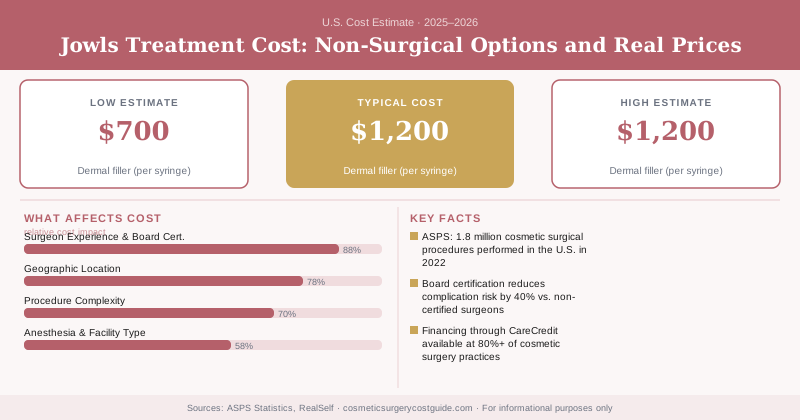
Most people assume jowls only happen to your grandparents. Wrong. Sagging along the jawline often starts in your late 30s as collagen production drops and the fat pads in your face begin to shift downward. The good news? You don’t necessarily need a facelift to address it. The pricier news? The non-surgical fix can still run several thousand dollars.
Let’s get into what jowl treatment actually costs and which option fits your face — and your budget.
What jowls treatment costs
Jowls form from a combination of skin laxity, volume loss, and gravity, so different treatments tackle different parts of the problem. That’s why prices range so dramatically.
| Treatment | Average Cost | What It Targets |
|---|---|---|
| Dermal filler (per syringe) | $700–$1,200 | Volume loss, jawline definition |
| Ultherapy (lower face) | $2,000–$4,000 | Skin laxity / collagen |
| RF microneedling (per session) | $600–$1,200 | Skin tightening, texture |
| Thread lift (lower face) | $1,500–$4,500 | Mechanical lifting |
| Mini facelift (surgical) | $4,500–$8,000 | Significant sagging |
According to the American Society of Plastic Surgeons, soft-tissue filler procedures topped 5.3 million in 2023, and jawline contouring is one of the most requested off-label uses. Energy-based tightening has grown alongside it as people look for facelift-style results without the downtime.
Match the treatment to your stage of sagging
For early, mild jowls, dermal fillers can restore lost volume along the jawline and create a sharper, lifted appearance. It’s the cheapest entry point at $700–$1,200 per syringe, though results last only 12–18 months.
Moderate laxity responds well to collagen-stimulating energy devices. Ultherapy uses focused ultrasound to tighten from the inside, while radiofrequency microneedling treats both skin tightness and surface texture. These cost more upfront but the results build over several months and can last a year or two.
Plan to spend $1,500–$5,000 on non-surgical jowl treatment. Fillers are cheapest but temporary; Ultherapy and RF tightening cost more but address actual skin laxity. If your jowls are advanced, a surgical mini facelift may deliver better value per year of results than repeated non-surgical sessions.
Thread lifts: the middle ground
A thread lift sits between fillers and surgery. Dissolvable barbed sutures are inserted under the skin to physically lift sagging tissue, with results lasting 12–18 months. At $1,500–$4,500 it’s not cheap, and the lift is subtler than a facelift, but it requires no general anesthesia and minimal downtime.
When non-surgical stops making sense
Here’s the honest math. If you’re spending $3,000 every 18 months on fillers and tightening, that’s roughly $2,000 a year. A surgical lower facelift might cost $6,000–$8,000 once and last 8–10 years. Over a decade, the non-surgical route can quietly cost more.
Don’t let a provider talk you into stacking five different treatments in one visit. Jowls rarely need filler, threads, and tightening all at once. Start with the single approach that matches your main issue, see how it responds, and add more only if needed. Over-treating is the fastest way to overspend.
Keeping costs reasonable
Filler is volume-based, so a smaller, well-placed amount along the jawline often beats a generous dose. Ask your provider how many syringes you genuinely need rather than accepting a round number. For energy treatments, ask whether one full Ultherapy session can replace three RF appointments — sometimes it can.
If you’re financing, spreading payments out is common in aesthetics; see our cosmetic surgery financing guide before signing anything with high interest.
The bottom line
Jowls treatment runs $1,500–$5,000 without surgery, and the smartest spend depends on whether your problem is lost volume, loose skin, or both. Fillers offer the cheapest start, energy devices the most natural long-term tightening, and surgery the most durable result. Get your face assessed honestly before you pay for anything.
Frequently Asked Questions
Ultherapy for jowls typically costs $2,000–$4,500 per treatment session, depending on the treatment area size and your provider's location. Most patients require one session, though some see better results with a second treatment 6–12 months later, which would add another $2,000–$4,500 to the total cost.
No, non-surgical jowl treatments like dermal fillers, Ultherapy, radiofrequency, and thread lifts are considered cosmetic procedures and are not covered by health insurance. You will pay the full out-of-pocket cost, typically ranging from $1,500–$5,000 depending on the treatment method chosen.
Results vary by treatment: dermal fillers last 6–12 months, thread lifts last 12–18 months, and Ultherapy or radiofrequency treatments can last 12–24 months before requiring touch-ups. Most patients schedule maintenance treatments annually to sustain their results, which means budgeting for repeat costs each year.