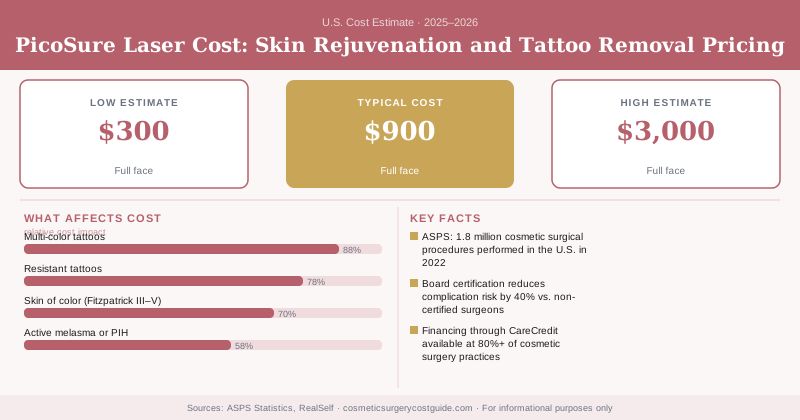
What does PicoSure actually cost in 2026? Cynosure’s picosecond laser does two different jobs — skin rejuvenation and tattoo removal — and the pricing, session count, and results look completely different for each application. Most providers quote them separately, and rightfully so. Here’s what you’ll pay for both.
PicoSure operates at 755nm wavelength with a pulse duration measured in picoseconds — trillionths of a second — compared to older Q-switched “nanosecond” lasers that fire in billionths of a second. That 1,000x faster pulse matters: faster energy delivery creates more photoacoustic (pressure wave) impact and less photothermal (heat) effect. For skin, that means collagen stimulation with less heat damage. For tattoo ink, it means ink particles shatter into finer fragments that your lymphatic system can clear more efficiently.
The American Society for Dermatologic Surgery (ASDS) reports tattoo removal has been one of the fastest-growing laser procedures for the past decade — and the adoption of picosecond technology has meaningfully changed patient outcomes in that category.
PicoSure Pricing: Skin Rejuvenation
| Treatment Area | Cost Per Session | Sessions Typically Needed | Total Estimate |
|---|---|---|---|
| Full face | $300–$600 | 3–5 | $900–$3,000 |
| Face + neck | $500–$800 | 3–5 | $1,500–$4,000 |
| Specific pigmented spots | $150–$400 | 1–3 | $150–$1,200 |
| Hands (age spots) | $200–$450 | 2–4 | $400–$1,800 |
| Neck/chest | $300–$600 | 3–5 | $900–$3,000 |
PicoSure’s 755nm wavelength is particularly effective on blue and black pigment, making it strong for melasma and hyperpigmentation. The device is also used in “Focus Lens Array” mode — a diffractive lens that concentrates energy into tiny pressure points to trigger collagen induction without ablation, similar in concept to non-ablative fractional treatment.
PicoSure Pricing: Tattoo Removal
| Tattoo Size | Cost Per Session | Sessions Typically Needed | Total Estimate |
|---|---|---|---|
| Small (under 2 sq in) | $100–$250 | 6–8 | $600–$2,000 |
| Medium (2–6 sq in) | $200–$400 | 6–10 | $1,200–$4,000 |
| Large (6–16 sq in) | $300–$500 | 8–12 | $2,400–$6,000 |
| Full sleeve/large coverage | $500–$1,000+ | 10–15+ | $5,000–$15,000+ |
| Single color (black only) | $150–$350 | 4–8 | $600–$2,800 |
| Multi-color (includes greens/blues) | $250–$500 | 8–14 | $2,000–$7,000 |
Many practices offer package pricing for tattoo removal — prepaying for 6 or 8 sessions typically saves 15–25% versus per-session rates. Because the total session count is genuinely hard to predict at the start (ink density, layering, skin type, and immune response all play roles), getting a conservative estimate from your provider is prudent before committing to a package.
Picosecond vs. Nanosecond: The Actual Difference
This is the comparison that matters most when evaluating PicoSure against older and lower-cost options.
| Technology | Pulse Duration | Mechanism | Best For | Cost/Session |
|---|---|---|---|---|
| PicoSure (picosecond 755nm) | Picoseconds (10⁻¹²s) | Photoacoustic + photothermal | Multi-color tattoos, pigmentation, skin rejuvenation | $200–$600 |
| PicoWay (picosecond 532/1064nm) | Picoseconds | Photoacoustic | Dark ink tattoos, darker skin tones | $200–$600 |
| Q-switched Nd:YAG (nanosecond) | Nanoseconds (10⁻⁹s) | Primarily photothermal | Black/dark ink, darker skin tones | $100–$350 |
| Q-switched Ruby | Nanoseconds | Photothermal | Pigmentation, green/blue tattoo ink | $150–$350 |
| Q-switched Alexandrite | Nanoseconds | Photothermal | Blue/green ink, pigmentation | $150–$400 |
For black-ink-only tattoos on lighter skin tones, an experienced practitioner using a Q-switched Nd:YAG can produce excellent results at significantly lower per-session cost. PicoSure’s advantage becomes clear with multi-color work — blues, greens, and purples that nanosecond lasers consistently struggle to clear. A 2015 study in the Journal of the American Academy of Dermatology demonstrated statistically superior clearance of blue and green tattoo ink with picosecond versus nanosecond treatment at comparable session counts.
For skin rejuvenation (not tattoo removal), PicoSure competes with IPL photofacials ($300–$600/session), Clear+Brilliant laser ($300–$500/session), and the MOXI laser in terms of positioning. PicoSure’s collagen-stimulation mechanism is different from IPL’s light-based approach, and it handles darker pigmentation and post-inflammatory hyperpigmentation more precisely than broad-spectrum light.
PicoSure’s higher per-session cost versus nanosecond lasers is justified in these specific scenarios:
- Multi-color tattoos with blues, greens, or purples — nanosecond lasers often plateau at partial clearance
- Resistant tattoos that haven’t responded adequately to Q-switched treatment
- Skin of color (Fitzpatrick III–V) for pigmentation and rejuvenation — the photoacoustic mechanism generates less heat, reducing hyperpigmentation risk
- Active melasma or PIH — the targeted energy profile is gentler on at-risk skin types
- Combined skin + tattoo treatment — a single PicoSure device handles both applications, convenient if you’re treating both concerns
If you have a simple black tattoo on fair skin, or purely want mild skin brightening, lower-cost alternatives may achieve comparable results.
What to Expect During and After Treatment
Skin rejuvenation sessions: Topical numbing is applied 30–45 minutes before treatment. The session takes 20–30 minutes for a full face. Immediately after, expect redness and mild swelling that typically resolves within a few hours to 24 hours — significantly less downtime than ablative fractional lasers. Most patients return to normal activities the same day or next morning, though makeup is best avoided for 24 hours.
For pigmentation and hyperpigmentation treatment, the dark spots often darken initially (a normal oxidation response) before gradually fading over 2–4 weeks. Don’t panic if your spots look worse before they look better.
Tattoo removal sessions: The sensation is more intense — described as repeated rubber band snaps on sunburned skin. Sessions for small tattoos take 5–10 minutes; large pieces run 20–30 minutes. Frosting (temporary whitening of the skin surface) occurs during treatment and fades within 20–30 minutes. Blistering is possible and normal; keep the area clean, apply antibiotic ointment, and don’t pick.
Sessions must be spaced a minimum of 6–8 weeks apart for tattoo removal. Booking faster doesn’t accelerate results — your immune system needs time between sessions to clear the shattered ink particles. Clinics that promise faster timelines are either compromising session intensity or misinforming you about the biology.
How Provider Quality Affects Results
PicoSure is an expensive piece of equipment, which means it’s used at legitimate dermatology and plastic surgery practices as well as med spas where operator training varies widely. For tattoo removal especially, the relationship between operator experience and outcome is significant.
An undertrained operator may:
- Use energy settings too low to effectively shatter ink, requiring more sessions
- Miss spots near tattoo edges due to inadequate overlap technique
- Inadequately adjust settings for skin tone, increasing scarring risk
When evaluating providers, ask how many PicoSure tattoo removal cases they’ve done, whether they have before/after photos for your tattoo’s colors, and whether they’ll adjust pricing based on progress at each session review.
For skin rejuvenation, PicoSure in the hands of a skilled dermatologist or aesthetician tends to produce consistent results for pigmentation and mild textural concerns. For more significant texture issues or deeper resurfacing, combining PicoSure with an ablative modality like CO2 laser or pairing it with microneedling with PRP addresses what picosecond treatment alone can’t reach.
Frequently Asked Questions
PicoSure skin rejuvenation sessions typically cost $300–$600 per treatment for the full face. Tattoo removal sessions run $200–$500 per session depending on tattoo size, with small tattoos often priced at the lower end and large or complex pieces at the upper end. Most skin patients need 3–5 sessions; tattoo removal varies from 6–12+ sessions depending on ink colors and depth.
PicoSure's picosecond pulse duration (trillionths of a second vs. nanosecond devices' billionths of a second) generates more photoacoustic energy and less heat, which means better ink shattering with less surrounding tissue damage. Clinical studies show faster clearance in fewer sessions for multi-color tattoos, particularly blues, greens, and purples that nanosecond lasers struggle with. However, cost per session is higher — patients typically spend more per session but need fewer of them.
Plan for 6–10 sessions for professional tattoos, spaced 6–8 weeks apart to allow your immune system to clear shattered ink particles between sessions. Amateur tattoos (less ink density) may clear in 4–6 sessions. Heavily saturated professional work, older tattoos with layered ink, or certain resistant colors (particularly dark green and teal) may require 12+ sessions regardless of laser type.