Here’s a frustrating fact: you can get those vertical lines above your lip without ever having touched a cigarette. “Smoker’s lines” — technically perioral or barcode lines — come from repetitive lip movement, sun damage, and collagen loss as much as from smoking. So if you’ve got them and you’ve never smoked, you’re in good company, and you’ve got plenty of treatment options.
The cost depends heavily on whether you’re filling the lines, resurfacing the skin, or relaxing the muscle. Let’s break it down.
What smoker’s lines treatment costs
These fine, etched lines sit in delicate, mobile skin, which makes them tricky to treat. Different tools attack them from different angles.
| Treatment | Average Cost | Notes |
|---|---|---|
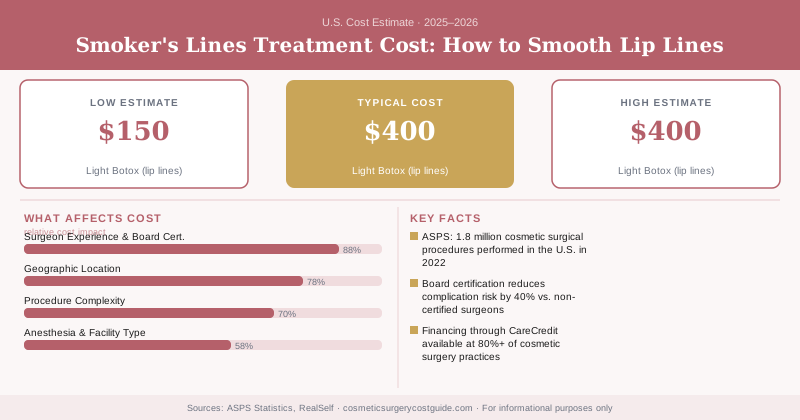
| Light Botox (lip lines) | $150–$400 | Relaxes the muscle |
| Fine-line filler (per syringe) | $600–$1,000 | Plumps the creases |
| Laser resurfacing (perioral) | $500–$1,500 | Rebuilds collagen |
| Microneedling (per session) | $200–$700 | Texture, mild lines |
| Chemical peel (perioral) | $150–$600 | Surface smoothing |
The American Academy of Dermatology notes that ultraviolet exposure accounts for up to 90% of visible skin aging, including these lip lines — which is why sun protection matters as much as any treatment. And the American Society of Plastic Surgeons recorded over 9.4 million neuromodulator procedures in 2023, with delicate perioral use growing steadily.
Botox first, but gently
A tiny dose of Botox in the muscle around the lips relaxes the puckering that etches these lines deeper. The key word is tiny — too much affects speech and smiling. At $150–$400 it’s the cheapest starting point, and it’s often used alongside other treatments rather than alone.
Filler for set-in lines
Once the lines are etched in, a fine-line dermal filler can plump them from below. This area needs a soft, thin product and a careful hand — it’s not the place for a heavy filler. Expect $600–$1,000 per syringe, though you rarely need a full syringe for just the lip lines.
Smoothing smoker’s lines usually costs $600–$2,500 total, depending on whether you combine treatments. Botox is the cheapest single option at $150–$400; laser resurfacing costs more but rebuilds the collagen that’s actually missing. For best results, most people layer a light approach over several months rather than fixing everything at once.
Resurfacing rebuilds what’s lost
If your lines come from genuine skin thinning and sun damage, no amount of filler or Botox replaces lost collagen. That’s where laser skin resurfacing earns its higher price. By controlled injury, it triggers fresh collagen and smooths the texture over weeks. A chemical peel offers a gentler, cheaper version of the same idea for milder lines.
Avoid overfilling the area above the lip. Heavy filler in delicate perioral skin can create a stiff, unnatural “monkey mouth” look that’s expensive to dissolve and correct. If a provider wants to load this zone with filler, slow down — a conservative, layered plan almost always looks better and costs less in the long run.
Smart ways to save
You probably don’t need a full syringe of filler for lip lines alone — ask whether a half-syringe or a shared session works. Combine a small Botox dose with a single resurfacing treatment instead of repeating filler endlessly. And don’t ignore the basics: daily SPF and stopping smoking slow new lines from forming, protecting whatever you’ve already paid to fix.
The bottom line
Treating smoker’s lines runs roughly $600–$2,500 depending on your approach. Light Botox is the cheapest entry, filler plumps etched lines, and laser resurfacing rebuilds the collagen that thinning skin has lost. The most cost-effective plan layers a couple of conservative treatments and protects the results with sun care — not a single expensive fix.
Frequently Asked Questions
Dermal filler treatments for smoker's lines typically cost $300–$1,000 per session, depending on the type of filler used and the number of lines being treated. Most patients require 1–3 sessions spaced 4–6 weeks apart, bringing total costs to $600–$2,500 for complete smoothing.
No, smoker's lines treatment is considered cosmetic and is not covered by health insurance plans. You will pay the full out-of-pocket cost, though some medical spas and dermatology offices offer payment plans or financing options to spread the expense over several months.
Dermal filler results typically last 6–12 months, after which the filler is gradually absorbed by the body and lines may begin to reappear. Laser resurfacing treatments provide longer-lasting results (12–24 months) but usually cost more upfront at $800–$2,500 per session.