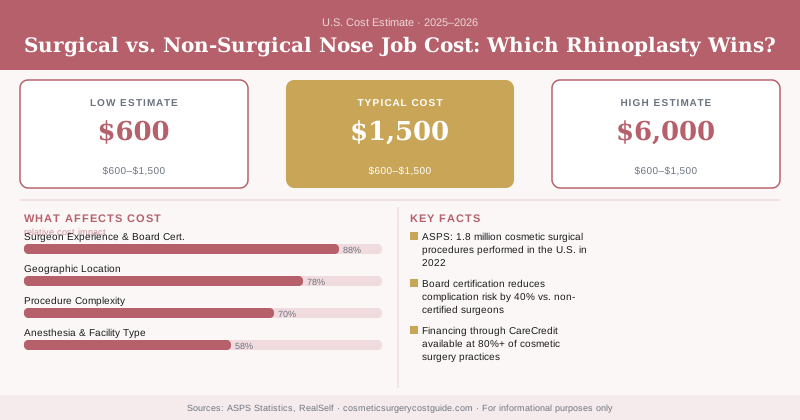
You can reshape a nose in fifteen minutes with a syringe, or in three hours with a scalpel. The first costs about a grand and lasts a year. The second costs several thousand and lasts a lifetime. So why would anyone choose one over the other? Because they fix completely different things, and choosing wrong wastes both money and your nose.
Rhinoplasty has long been one of the most-performed facial cosmetic surgeries. The Aesthetic Society’s 2023 data ranked it among the top facial surgical procedures in the country, with hundreds of thousands done each year.
| Non-Surgical Nose Job | Surgical Rhinoplasty |
|---|---|
| $600–$1,500 | ~$6,000 surgeon fee |
| Filler injections | Reshapes bone and cartilage |
| Can only add, not reduce | Can reduce and reshape |
| Lasts 6–18 months | Permanent |
| No downtime | 1–2 week recovery |
What the non-surgical version can do
A non-surgical “liquid” nose job uses dermal filler to smooth out bumps, lift the tip slightly, or improve symmetry. By adding filler above and below a bump, a skilled injector can make the nose look straighter, even though nothing was removed. It’s fast, has no downtime, and the result is reversible if you don’t love it.
But here’s the hard limit. Filler can only add volume, never reduce it. So if your goal is a smaller nose, narrower bridge, or reduced tip, filler can’t do that. It can actually make a large nose look bigger. Our dermal fillers cost guide explains how the syringe price is set.
What surgery can do
Surgical rhinoplasty reshapes the actual bone and cartilage. It can reduce a hump, narrow the bridge, refine or rotate the tip, and fix breathing problems. It’s the only option for genuinely making a nose smaller or correcting structural issues. The full rhinoplasty cost guide breaks down surgeon, anesthesia, and facility fees.
It costs far more and involves real recovery, but the result is permanent.
Want to smooth a small bump, lift the tip, or correct minor asymmetry without surgery? The non-surgical option is a low-cost, reversible win. Want to reduce nose size, narrow the bridge, or fix breathing? Only surgery can do that, and filler would be a waste of money for those goals.
The cost-per-year math
A liquid nose job at $1,000 lasting a year means you’ll re-treat repeatedly. Over five years, that’s potentially $5,000, edging toward the price of permanent surgery, and you only ever got the “add volume” effect.
For the right candidate, that recurring cost is fine. For someone who actually wants reduction, no amount of filler money buys the result they’re after.
Filler in the nose carries a rare but serious risk: injected into the wrong vessel, it can compromise blood flow to the skin or, very rarely, the eyes. This is precisely why the nose should only be injected by an experienced, medically trained provider, never at a discount med-spa with an inexperienced injector.
Can a liquid nose job buy you time?
Some patients use filler to “preview” a change or delay surgery. It’s a reasonable trial, but be honest with yourself: if you ultimately want surgery, repeated filler is money spent on a temporary look. There’s also a practical wrinkle, scar tissue from repeated filler can occasionally complicate a future surgical rhinoplasty, so tell your surgeon if you’ve had injections before.
Revision and the long view
Surgical rhinoplasty isn’t always one-and-done either. A meaningful share of patients consider a minor revision down the line, which adds cost, so factor that possibility into your budget. The flip side is that when the result is right, it’s permanent, you never pay for it again. With filler, you’re effectively renting the look year after year, and the costs quietly accumulate. Weigh the one-time investment against the recurring spend before you decide which is truly cheaper for your goals.
Downtime
Non-surgical is essentially zero downtime, maybe some swelling or a small bruise. Surgery means a splint for a week, swelling for weeks, and final results that refine over months.
Bottom line
Small additive tweaks and reversibility? Go non-surgical and save thousands. Reduction, structural change, or breathing issues? Surgery is the only path, and filler would just delay the inevitable. To budget a surgical rhinoplasty, our cosmetic surgery financing guide covers monthly payment options.
Frequently Asked Questions
A non-surgical nose job using injectable fillers typically costs $600–$1,500 and lasts about one year, while surgical rhinoplasty averages around $6,000 and provides permanent results. The price difference reflects the complexity: non-surgical procedures take 15 minutes with minimal downtime, whereas surgical rhinoplasty requires 2–3 hours in an operating room and several weeks of recovery.
Insurance rarely covers cosmetic rhinoplasty since it's considered elective, meaning you'll pay the full cost out-of-pocket; however, if the surgery corrects a breathing problem (functional rhinoplasty), insurance may cover 50–90% of the procedure. Non-surgical nose jobs are never covered since they're purely cosmetic and temporary.
Non-surgical nose jobs last approximately one year, requiring annual touch-ups costing $600–$1,500 each, while surgical rhinoplasty results are permanent with a single upfront investment of around $6,000. If longevity matters to your budget, surgical rhinoplasty becomes more cost-effective after 5+ years of maintenance on non-surgical alternatives.