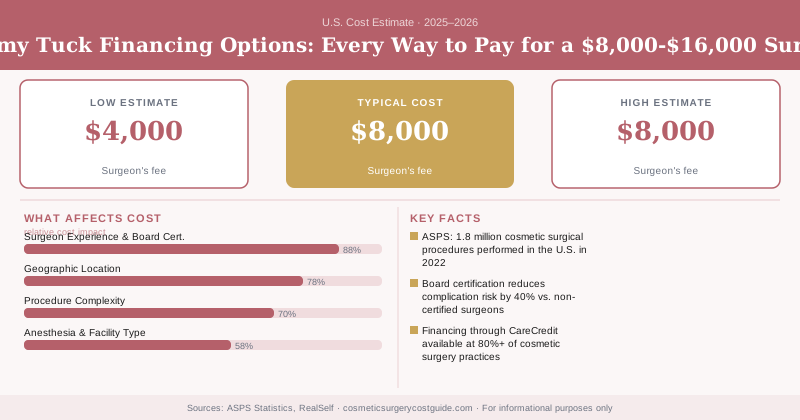
Numbered protocol for financing a tummy tuck without getting burned: get your real total cost first, match the financing product to your actual payoff timeline, verify the fine print on deferred interest, and build in a buffer for recovery-period costs. Skip any of these four steps, and you risk paying thousands more than the surgery itself.
Step 1: Get an accurate total cost
| Component | Cost Range |
|---|---|
| Surgeon’s fee | $4,000–$8,000 |
| Anesthesia fee | $1,000–$2,000 |
| Facility/OR fee | $1,500–$3,000 |
| Compression garments/supplies | $150–$400 |
| Total typical cost | $8,000–$16,000 |
| Combined with liposuction | $10,000–$18,000 |
Get your surgeon’s fully itemized quote before shopping financing. A tummy tuck’s price swings meaningfully based on whether you need muscle repair (diastasis recti correction), how much excess skin is removed, and whether liposuction is combined — all of which change your total financing need.
Step 2: Match the financing product to your payoff timeline
If you can pay off the balance within 12-24 months, a medical credit card’s 0% promotional period is typically your cheapest option — but only if you’re confident in hitting that deadline. Run the numbers: a $12,000 balance over 18 months requires roughly $667/month to pay off before the promotion ends.
If you need longer than 24 months, or you’d rather have a guaranteed, predictable rate without deferred-interest risk, a fixed-rate personal loan through Prosper Healthcare Lending or your own bank/credit union is usually the better structural fit, even though it means paying some interest regardless of how quickly you repay.
Step 3: Verify the deferred interest fine print
Before signing for any medical credit card, ask explicitly: “If I don’t pay off the full balance by the end of my promotional period, is the interest calculated retroactively from my original purchase date, on the entire original balance?” For CareCredit and Alphaeon, the answer is yes — this deferred interest structure is what catches patients off guard, turning a nearly-paid-off balance into a much larger one overnight if the deadline is missed by even one payment cycle.
Step 4: Budget for the recovery period, not just the surgery
Tummy tuck recovery typically requires 2-4 weeks away from normal activity and often 4-6 weeks before returning to strenuous exercise or heavy lifting. Factor in potential lost income, childcare help, or household assistance during this window — these costs are easy to overlook when financing focuses entirely on the surgical bill itself. See our tummy tuck recovery cost guide for a fuller breakdown of what recovery actually involves financially.
If your credit isn’t strong enough for standard cards
Patients declined by CareCredit or Alphaeon (which typically require a credit score around 620+) aren’t out of options. United Medical Credit’s lender marketplace specifically serves fair and poor credit applicants, though at meaningfully higher rates. Some surgical practices also offer in-house payment plans requiring a larger upfront deposit (commonly 30-50%) with the remainder paid directly to the practice over a shorter window, bypassing a credit check entirely.
Combining with other procedures changes the math
Many patients combine a tummy tuck with breast surgery as part of a broader mommy makeover, which typically lowers the combined per-procedure cost through shared anesthesia and facility fees — meaning a smaller total amount to finance than doing each procedure as a separate surgery.
The medical necessity exception
If your abdominal skin excess is severe enough to cause chronic rashes, skin infections, or significant hygiene difficulty, a panniculectomy (removal of the overhanging skin, distinct from a cosmetic tummy tuck) may qualify for partial insurance coverage with proper physician documentation. This can meaningfully reduce the out-of-pocket amount you actually need to finance — worth exploring with your surgeon and insurer before assuming the full cost is on you.
Avoid financing 100% of your tummy tuck cost if at all possible. Even a modest cash contribution toward the total — 10-20% — meaningfully reduces your monthly payment, shrinks your total interest exposure, and lowers the stakes if your promotional period financing isn’t fully paid off on schedule.
Bottom line
Tummy tuck financing spans 0% promotional medical credit cards, fixed-rate personal loans, and practice-specific payment plans — with the right choice depending on your credit and realistic payoff timeline. Get your itemized quote first, verify the deferred interest fine print before signing anything, and build a buffer for recovery-period costs beyond the surgical bill itself.
Frequently Asked Questions
The main tummy tuck financing options are medical credit cards (CareCredit, Alphaeon) with 0% promotional periods, fixed-rate personal loans through marketplaces like Prosper or United Medical Credit, personal loans from your own bank or credit union, and in-house payment plans offered directly by some surgical practices. The best choice depends primarily on your credit profile and how quickly you can realistically pay off the balance.
Insurance may cover a medically necessary panniculectomy (removal of overhanging abdominal skin causing rashes, infections, or hygiene issues), which can reduce your out-of-pocket amount needing financing, but purely cosmetic tummy tuck procedures are never covered. If your case might qualify for partial medical necessity coverage, ask your surgeon to document and submit for prior authorization before finalizing your financing plan.
Most financing products can cover the full tummy tuck cost, typically $8,000-$16,000, up to their respective credit limits (often up to $25,000 for medical credit cards). Some patients choose to pay a portion in cash upfront specifically to reduce the financed amount and lower their total interest cost or monthly payment.